

What It Does
- Custom Prompting: Generate AI responses based on any prompt and dataset—personalized row by row.
- Structured or Free-Form: Choose between natural text or JSON-style structured output.
- Supports Web Search: Enable external search for richer answers on supported models.
- Column Auto-Mapping: Dynamically maps fields and avoids name collisions for smooth output.
- Model Flexibility: Run on multiple OpenAI models including GPT-4o and GPT-4o-mini.
🏁 Getting Started
(Optional) Configure JSON Schema
For structured output, define expected fields using a simple JSON schema.
Inputs
🛠️ Required Fields
-
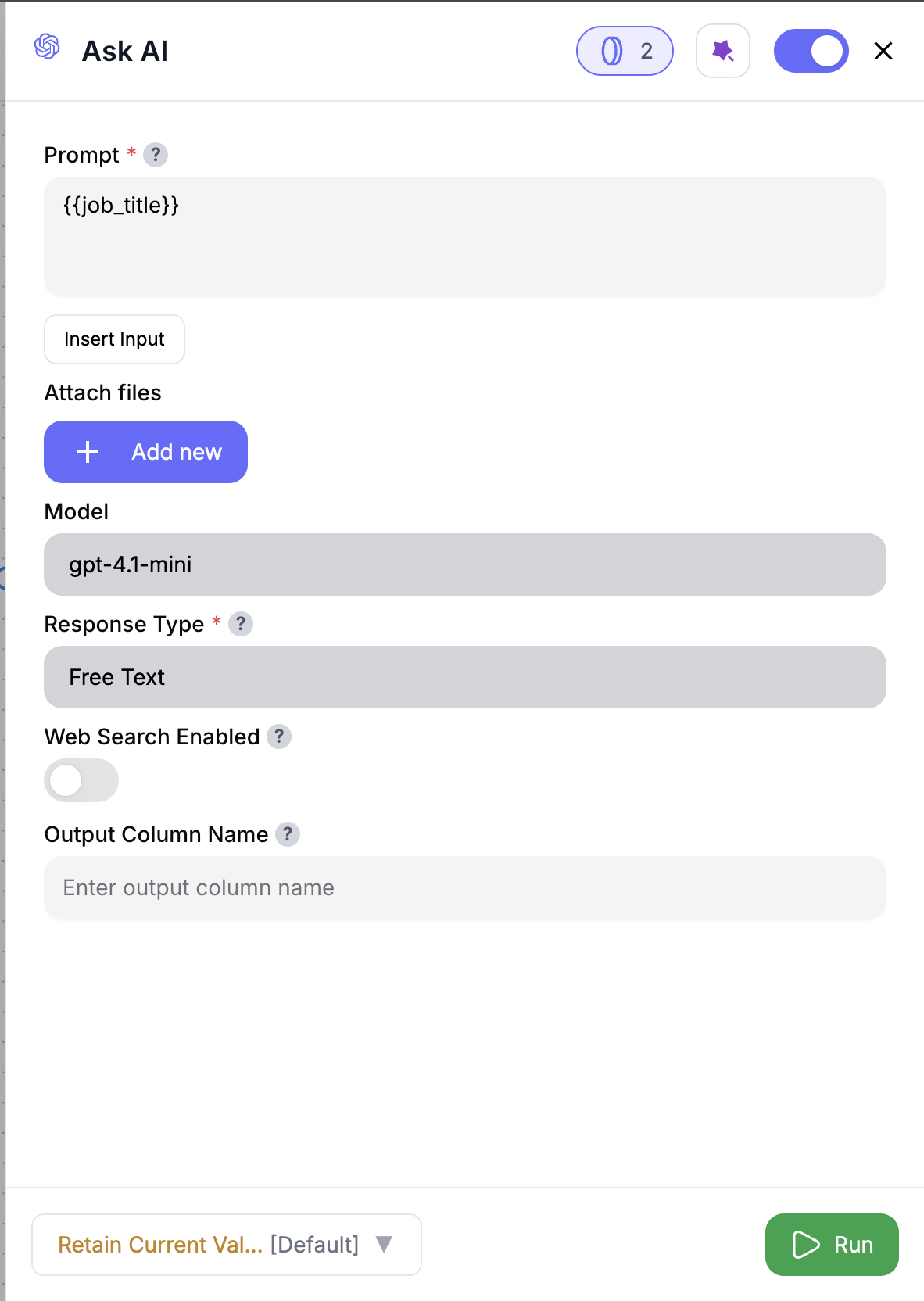
Prompt (✅)
Write your instruction using@column_namereferences or Insert Input.
Why it matters: The AI uses this row-by-row to tailor each result. -
Model (✅)
Choose betweengpt-4o-mini(default),gpt-4o, or any other supported OpenAI model.
Why it matters: Affects quality, speed, and credit cost. -
Response Type (✅)
Choosefree_text(default) orstructured_output.
Why it matters: Controls whether you get one column (text) or multiple (JSON→columns). -
Web Search Enabled (✅)
Toggle On/Off for real-time context injection on supported models.
Why it matters: Improves freshness of answers but adds cost + latency.
🎯 Optional Fields
-
Response JSON (⚪️)
Required ifstructured_outputis selected. Use sample JSON to define column layout. -
Output Column Name (⚪️)
Applies only to free-text output. Default isRESPONSE.
We also support Latest OpenAI model- gpt-5.1!!
Output
-
Free Text Output
- Adds one column:
RESPONSE(or renamed output)
- Adds one column:
-
Structured Output
- Adds one column for each key in your JSON schema
How It Works
- Injects column values dynamically from each row into your prompt
- Sends request to your selected model (with web search if enabled)
- Parses output as free text or structured JSON
- Adds result(s) to each row of your table
- Automatically renames fields if name conflicts occur
🚀 Example Use Cases & Prompts
| Use Case | Prompt |
|---|---|
| Product Suggestions | ”Suggest products for @customer_name based on their history: @purchase_history” |
| Feedback Sentiment | ”Analyze sentiment for @customer_name based on: @feedback” |
| Lead Scoring Summary | ”Summarize activity for @lead_name and recommend next step.” |
| Job Title Classifier | ”Classify job title into Sales, Marketing, or Engineering: @title” |
| Category Mapping | ”Assign a product category to this item: @product_name” |
✨ Pro Tips
⚠️ Important Considerations
🛠 Troubleshooting & Gotchas
| Symptom | Likely Cause | Quick Fix |
|---|---|---|
| No output generated | Missing column in prompt | Use Insert Input or double-check @references |
| All rows = same answer | Static prompt with no dynamic data | Add @column_name to personalize per row |
| Slower than expected | Web search enabled | Turn off unless needed |
| Output columns missing | Missing or malformed JSON schema | Add a valid JSON schema |
📝 FAQ
Can I use multiple Ask AI nodes?
Can I use multiple Ask AI nodes?
Yes — chain as many as you’d like for layered classification, insights, or scoring.
Can I mix free text and structured output?
Can I mix free text and structured output?
Not in the same node. Use separate nodes if you need both types.
What happens if a row errors out?
What happens if a row errors out?
The row is preserved, but the output column will show an error message.
💰 Pricing
Ask AI is billed per processed row:| Model | Credits / Row | Notes |
|---|---|---|
| GPT-5.1 | 5 | Most advanced, top reasoning |
| GPT-5 | 5 | Near-frontier intelligence |
| GPT-5 mini | 3 | Efficient, strong reasoning |
| GPT-5 nano | 2 | Ultra-light, fast responses |
| GPT-4.1 | 3 | Balanced performance |
| GPT-4.1 mini | 2 | Lightweight, optimized |
| GPT-4.1 nano | 1 | Very fast, minimal compute |
| GPT-o3 | 4 | Legacy model, stable output |
| GPT-o4 mini | 4 | Improved mini-tier model |
| gpt-4o-mini | 1 | Fast, lightweight |
| gpt-4o | 4 | Premium model, deeper reasoning |
Each
Web Search toggle adds +2 credits/row to your base cost.Add Ask AI to your workflow and turn raw data into answers, summaries, and classifications — all without switching tools. ⚡🧠